



Insight
<<trp-gettexdiv class="title">
Ist bei der MPU die halbe Miete </division>Every year, around 100,000 drivers have to undergo an MPU after losing their driving licence.
The legislator obliges all those who have lost their driving licence and wish to regain it: be it due to severe alcohol abuse, drug consumption or after accumulating 18 points in the Flensburg traffic register – for taxi drivers and other professional drivers, this applies after just nine points.
The legislator obliges all those who have lost their driving licence and wish to regain it: be it due to severe alcohol abuse, drug consumption or after accumulating 18 points in the Flensburg traffic register – for taxi drivers and other professional drivers, this applies after just nine points.
If the driving licence has been revoked for longer than two years, in addition to the MPU (medical-psychological examination), a re-examination for the driving licence may also be ordered.
Furthermore, there are those who have never held a driving licence but have a drug-related offence on their criminal record and will only be permitted to take the driving test after successfully completing an MPU. The aim is to determine their fitness to drive.
In the medical section, a doctor asks about any existing illnesses. He also wants to know if medication is taken regularly. If alcohol or drugs were the cause for the driving licence being revoked, more extensive blood and urine tests will be carried out, and the doctor will also be interested in the Gamma-GT levels, the so-called liver values, for these candidates. The reaction test on the computer checks concentration and perception ability.
The further fate of your driving licence hinges most strongly on the "four-eyes" conversation with a psychologist. There are no right or wrong answers in this. You just need to credibly convey that you have come to terms with the causes of your misconduct and have taken effective countermeasures. Therefore, under no circumstances should you downplay the mistakes that led to the loss of your licence or try to blame others for them.
Legal proceedings 100%
Medical relationships 99%
Compliance audits 95%


ATTENTION!
<<trp-gettexdiv class="title">
Hier ist der wichtige Punkt. Macht man hier etwas falsch, kann man beim MPU-Test schneller durchfallen, als man blinzeln kann. </division>Psychological help and addiction therapy are essential for a large number of MPU candidates, says ABV managing director Karin Müller. She illustrates this with the topic of drink-driving. You must attend an MPU if you were caught driving with a blood alcohol level of 1.6 per mille or more. Such values are a clear indication that someone has not just let themselves go by mistake, says Müller. This indicates a serious alcohol problem.
The qualified psychologist thinks little of crash courses often costing €5,000 with a «guarantee of success»: «Such three-day programmes cannot be effective.«, says Müller.
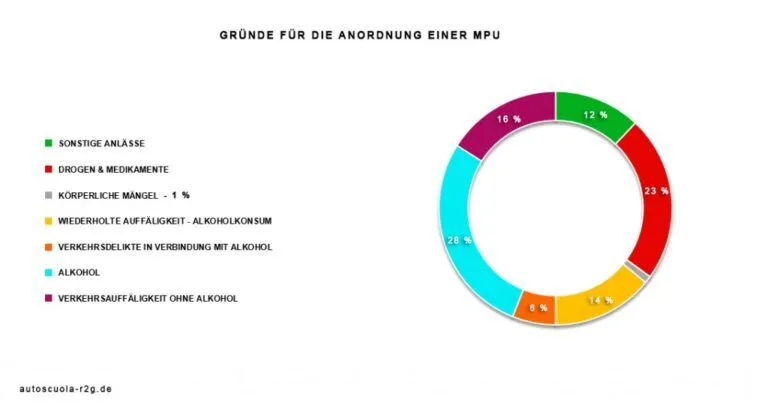
According to statistics, of the roughly 100,000 people who undergo MPU annually nationwide, two-thirds do so because of drink-driving, and 20 per cent attend after drug or medication abuse. The remaining 14 per cent are those who have accrued penalty points. Extreme driving behaviour on the roads, and consequently the MPU, is almost exclusively a male issue. The proportion of women summoned for the examination is a mere five per cent.
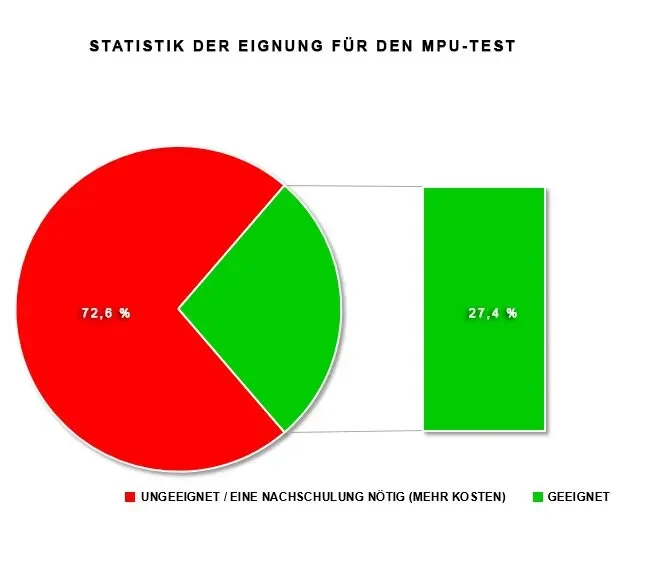
Karin Müller adds another figure to the statistics: around 27.4 percent of candidates clear the hurdle the first time, she says. Those who didn't manage it can, in principle, reapply as often as they like until they eventually receive a positive assessment. However, the examination is associated with considerable costs.

 German
 Polish
 Arabic
 Turkish
 French
 Dutch
Dutch English